|
Peanuts do not grow on trees nor do they develop as part of the root
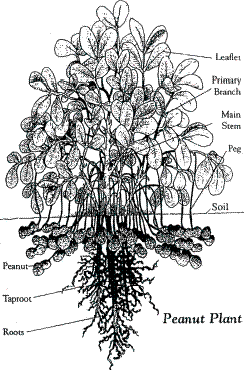
of the plant. They are classified as a Peanuts are a nitrogen-fixing plant, which means the roots form nodules that absorb nitrogen from the air to help feed the plant. This also enriches the soil. Peanuts are unusual in that the plant flowers but the fruit grows underground. The flowers loose their petals after fertilization and the budding ovary or peg grows down away from the plant on a stem that pierces the soil and grows into the peanut. Each plant will produce around 40 mature peanut pods. Peanuts have a growing period of approximately 5 months. In the northern hemisphere they are typically sown mid-April to mid-May, and harvested during September and October. Light, sandy loam soils are preferred for peanut production. Moderate annual rainfall of between 51 and 102 centimetres annually is also necessary.
It is rare to get supplies from North America, this year only in shell peanuts are coming from China where most of their production is taken up by internal consumption and there are currently no peanuts coming from India although there may be some later. No peanuts are being offered from Africa where aflatoxin has been an issue. South America is currently the best area for supply and the quality from Brazil and Argentina is good but drought is causing some concerns for later this season. |
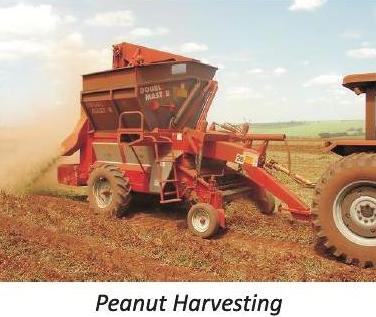
The initial step in processing is peanut harvesting, which typically
begins with the mowing of mature peanut plants. Then the peanut plants are inverted by specialized machines, that dig, shake, and place the peanut plants, with the peanut pods on top, into rows for field curing. In North and South America harvesting is normally followed by mechanical drying. In Asia and Africa it is more usual to air dry in the open fields. Moisture in peanuts is usually kept below 12 percent, to prevent aflatoxin moulds from growing.
After harvesting, some peanuts are processed for in-shell roasting.
The pods are washed in wet, coarse sand that removes stains and
discolouration. The sand is then screened from the peanuts for reuse.
The nuts are then dried and Peanuts are primarily grown for human consumption and it is the surplus or rejects that go into the animal feed chain. |
 legume,
which puts them in the same family as peas.
legume,
which puts them in the same family as peas.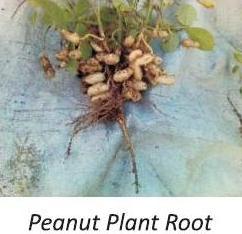 The
principal growing areas are North and South America, India, North
and South Africa, and China. The crop is a difficult one to grow
successfully as the weather conditions at all stages have to be right
and too much or too little rain or sun at the wrong time can result
in total crop failure. In a typical year there is usually one region
that has a failure.
The
principal growing areas are North and South America, India, North
and South Africa, and China. The crop is a difficult one to grow
successfully as the weather conditions at all stages have to be right
and too much or too little rain or sun at the wrong time can result
in total crop failure. In a typical year there is usually one region
that has a failure.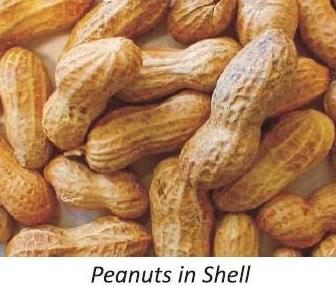
 powdered
with talc or kaolin to whiten the shells.
powdered
with talc or kaolin to whiten the shells.